Mike Tran

M.S Student·IDiR Lab, University of Texas at Arlington

I'm passionate about neural network model architecture, web development and automation practices. I enjoy building clean, robust, and maintainable systems. A well-written codebase is a work of art to me. My experience spans research, machine learning, web development, and cloud technologies. I'm also a novice photographer and a gamer in my free time.

Experience & Education

2022

2023

2024

2025

2026

Work

Research Assistant

IDiR Lab, University of Texas at Arlington · May 2024Present

  • Develop a full-stack dashboard for RDF database using Streamlit, Plotly, Cytoscape.js, and Mapbox to provide interactive graph visualizations
  • Containerized the complete application infrastructure with Docker for streamlined deployment and scalability. – Integrated Large Language Models (LLMs) using LangChain to enable natural language querying of the graph database
  • Implemented a Retrieval-Augmented Generation (RAG) pipeline enhanced with vector search capabilities using MongoDB Atlas Vector Search

Projects

mirage-landscape — On-Device 4K Landscape Diffusion Model

mirage-landscape — On-Device 4K Landscape Diffusion Model

I built an end-to-end pipeline for on-device 4K landscape image generation. I fine-tuned Google's DDPM-Church diffusion model on 60,000 images from the Landscapes HQ dataset using Hugging Face Diffusers, producing a diffusion model specialized in landscape image generation, and deployed the fine-tuned weights to Hugging Face at crab27/ddpm-landscape. The pipeline chains the 256×256 DDPM output with Real-ESRGAN upscaling to produce 4K landscape images — one of the few landscape diffusion projects packaged as an on-device CLI tool, distributed on PyPI as mirage-landscape and runs 100% locally after the first model download.

Python, PyTorch, Hugging Face Diffusers, DDPM, Real-ESRGAN, DPM-Solver++
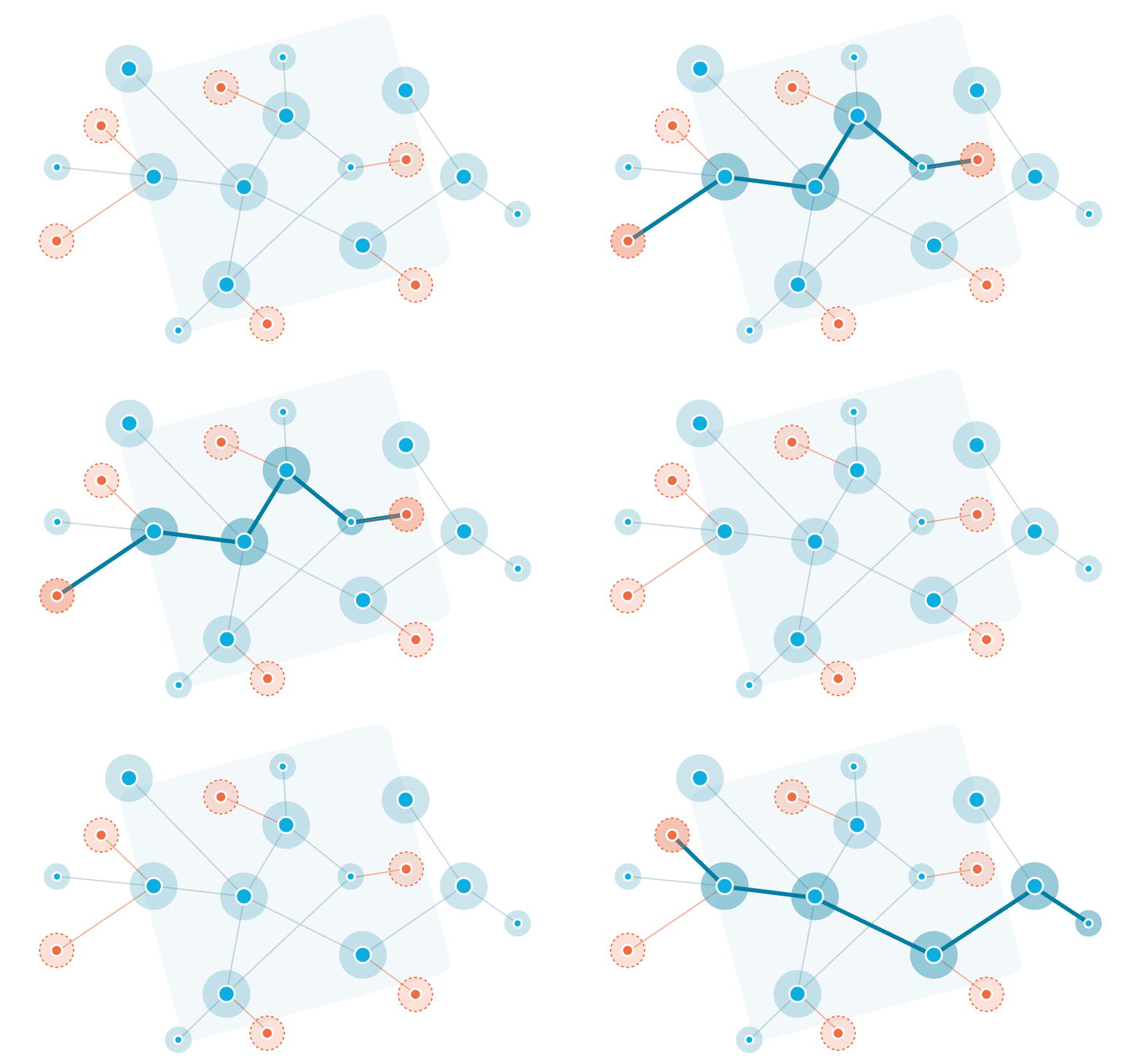
Sparql Profiler: A Tool for Automated Proling Knowledge Graphs

Sparql Profiler: A Tool for Automated Proling Knowledge Graphs

Knowledge graphs (KGs) are widely used to represent complex relationships between entities in various domains, such as healthcare, finance, and e-commerce. Heterogeneous KGs often contains hundreds of classes and thousands of properties, making it challenging for users to understand the structure and content of the graph. To addres this, we developed a tool to automatically profile KGs and generate comprehensive reports that summarize key statistics and insights about the graph.

CornVision — Corn Kernel Detection & Phenotyping

CornVision — Corn Kernel Detection & Phenotyping

I built a novel computer vision pipeline for corn ear phenotyping that detects, counts, and spatially organizes individual kernels from ear images. The detection model is a Faster R-CNN with a ResNet50 FPN v2 backbone, with the RPN replaced by corn-specific small anchors tuned for densely packed objects. Trained on a custom dataset of high-resolution images annotated in COCO format. After detection, kernels are grouped into rows via a sweep-line neighbourhood graph and BFS clustering, with partial edge rows removed by x-range ratio, and average kernel height/width reported in millimetres via a calibrated pixel-to-mm factor. Distributed as the cornvision PyPI package with a desktop GUI, a programmable Python API, and a containerized web demo (Docker) at https://corn.huytran.us. Model weights hosted on Hugging Face at crab27/corn-kernel-detection.

Python, PyTorch, torchvision, Faster R-CNN, ResNet50 FPN v2, COCO, CVAT, Hugging Face Hub, Docker, PyPI
Dashboard for RDF Graph Database with LLM Integration

Dashboard for RDF Graph Database with LLM Integration

Writing SPARQL queries is notoriously difficult for non-experts due to its complex syntax and steep learning curve, not to mention the need to understand the underlying graph structure and relationships between entities. To address this challenge, we developed an interactive dashboard that allows users to interact with the graph using either a predefined set of filters or natural language queries powered by Large Language Models (LLMs).

PythonStreamlitKnowledge Graph